
[From the Coaching Zone // World Cup Perspective #4]
Why Austria's Pressing Against Argentina Didn't Work
Following the 2–0 defeat to Argentina, the overall reaction surrounding the Austrian national team was largely positive. Head coach Ralf Rangnick expressed satisfaction with many aspects of the performance, while several players stated that they had made life difficult for the world champions.
Indeed, Austria displayed aggression, intensity, and resilience throughout the match. No one could accuse the team of surrendering to their opponents. They invested enormous physical effort, competed fiercely in duels, and repeatedly attempted to put Argentina under pressure high up the pitch.
But does this impression hold up under closer tactical scrutiny?
In my previous column, I pointed out how crucial it would be for Austria to press Argentina high in order to isolate Lionel Messi from the rest of his team. The idea was straightforward: if Argentina could not progress cleanly into midfield, it would become much more difficult to find Messi in the dangerous spaces between the lines.
The game plan therefore made perfect sense. Austria wanted to press high, disrupt Argentina's build-up, and force the world champions into rushed or uncontrolled decisions. In practice, however, this approach only worked in phases. Time and again, after just a few pressing actions, Austria was pushed back into a mid-block.
This raises the key question: was Austria's performance—and especially its pressing—as effective as many observers suggested immediately after the match?
The Data Tells a Different Story
Before examining the tactical footage, it is worth taking a closer look at the numbers.
Argentina's Back Four Enjoyed Outstanding Passing Accuracy
Argentina's back four recorded passing accuracies of 86%, 96%, 95%, and 91%, averaging 92%.
High passing percentages among defenders are, of course, not unusual. However, when a team presses consistently and effectively, that pressure should also be reflected in the opponents' passing statistics. Centre-backs are normally forced into more long balls, riskier decisions, or technical mistakes.
That was rarely the case against Austria. Argentina was able to circulate possession comfortably across the defensive line for long periods and repeatedly found solutions to bypass Austria's pressure.
PPDA: Argentina Pressed More Effectively
Another important indicator is the PPDA value.
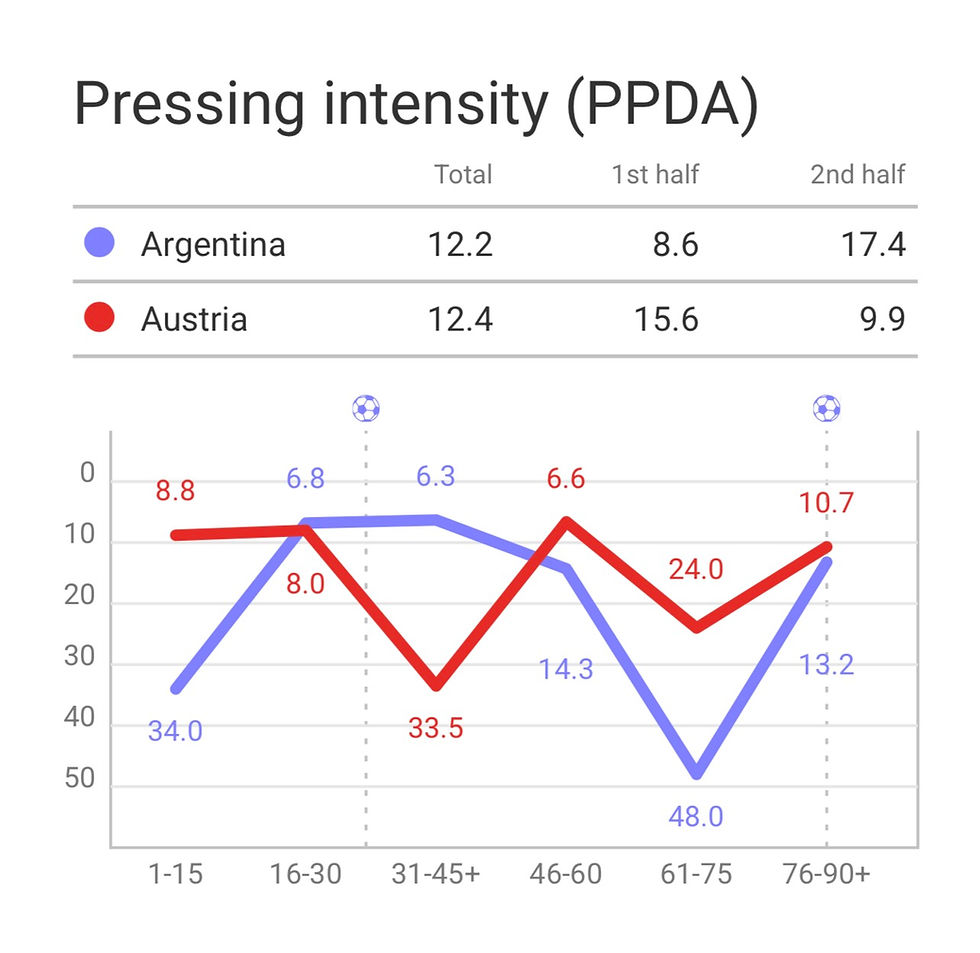
PPDA (Passes Per Defensive Action) measures, in simple terms, how many passes the opposition is allowed to complete before a team makes a defensive intervention. The lower the number, the more aggressive and effective the pressing.
In the first half, Austria recorded a PPDA of 15.6. For a team whose playing identity is built around proactive high pressing, this is a relatively poor figure. By comparison, Europe's elite pressing teams regularly post PPDA values between 6 and 8.
The comparison with Argentina is even more revealing. The South Americans registered a PPDA of 8.6 in the first half—even though Lionel Messi contributed very little defensive work. In reality, Argentina often defended effectively with only ten outfield players, yet still managed to press significantly more efficiently than Austria.
Ball Recoveries as the Decisive Benchmark
Ultimately, the quality of pressing is not determined by the number of pressing runs, but by their outcome.
How many ball recoveries does the press actually produce? How many of them occur in advanced areas? And how many lead to dangerous situations?
This is exactly where the problem becomes particularly clear.
Against Argentina's build-up play, Austria managed only one single ball recovery in the opposition half in the first half. For a team whose playing identity is based on high pressing, ball recoveries, and quick transition moments, this is an extremely low figure.
Of course, the exceptional quality of the opponent must be taken into account. Nevertheless, the decisive question remains: if a team invests so much energy and still produces only one high ball recovery, how effective was the pressing really?
Together with the high passing percentages of Argentina's back four and Austria's weak PPDA value, the picture becomes very clear: Austria wanted to press, but rarely managed to force Argentina into mistakes. The issue was not intensity. The issue was effectiveness.
Where Did the Problem Lie?
In my view, the main issue was Austria's first pressing line.
At times, Austria pressed high in a 4-2-4 shape. For this system to work, the four highest players must guide the opposition's build-up, close passing lanes, and pull the rest of the team forward with them.
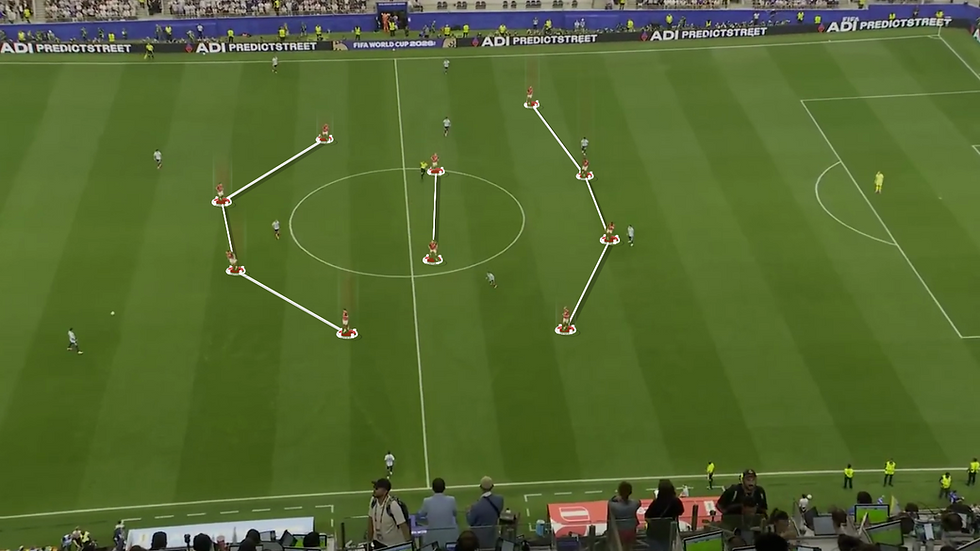
That is exactly what Austria failed to do often enough against Argentina.
1. The distances were too large
The first scene highlights a fundamental problem in Austria's pressing.
The forwards initiated the press, but the rest of the team did not push up consistently behind them. Above all, the back four remained relatively deep.
This was understandable, given the respect Austria had for Argentina's quality. No team wants to be bypassed by a single pass against players of that calibre. Nevertheless, high pressing loses its effect if the team does not move forward together.
Pressing has to be synchronised. When the first line applies pressure, the midfield and defensive line must reduce the distances behind it. If that does not happen, large spaces open up between the forwards and the back line.
Argentina repeatedly exploited exactly those spaces to play their way out of pressure.
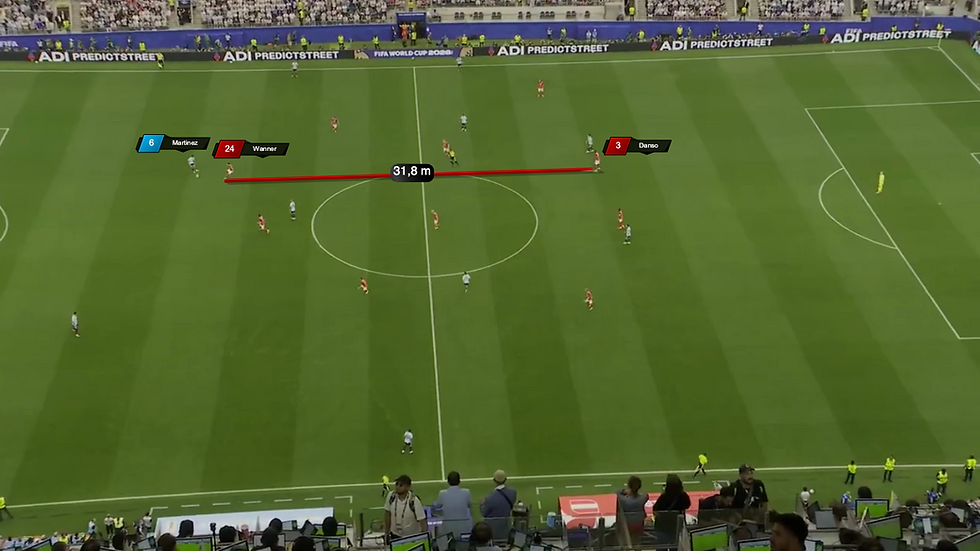
2. The Press Was Triggered Too Late
The second scene highlights a problem of timing.
A classic pressing trigger is a square pass from one centre-back to the other. At that moment, the ball is travelling, the receiver still has to control it, and the pressing team can immediately apply pressure.
In this case, however, Austria missed exactly that moment.
Gregoritsch's pressing run was not triggered at the moment the pass was played, but only once the ball was already on its way. At this level, those fractions of a second often make the difference. The receiver is able to control the ball and prepare his next action before real pressure arrives.
At the same time, there is no clear pressing intention. Does Gregoritsch want to attack the ball-carrying centre-back directly with high intensity, or does he want to use his running angle to close the passing lane to the other centre-back? Both would be possible, and both can be part of a functioning pressing structure.
In this scene, however, the intention remains unclear. The pressing action is not executed decisively enough, creating a compromise solution. The player in possession is not put under immediate pressure, while important passing options remain open.
Sabitzer's role is particularly striking. Due to Molina's extremely high positioning, Sabitzer is effectively taken out of the press. Molina is already positioned beyond the pressing line and, at the same time, outside Sabitzer's immediate reach. Sabitzer can neither apply pressure to the ball nor control Molina effectively. As a result, Austria loses an important pressing player before the actual pressing action has even begun.
While Gregoritsch fails to establish clear access to the ball carrier, Argentina still has a free passing option available.

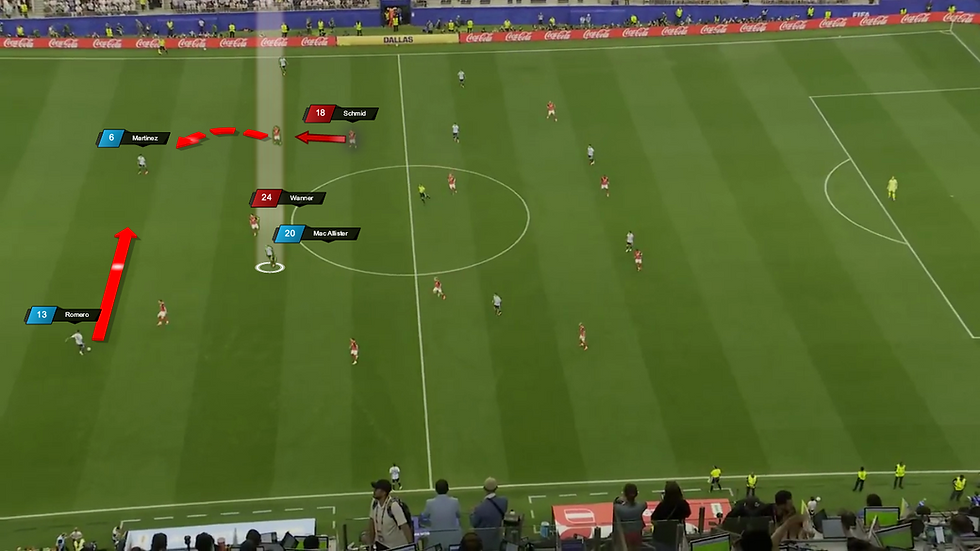
3. The Problem with Mac Allister
The third scene highlights a structural problem in Austria's pressing.
Austria wanted to prevent Alexis Mac Allister from receiving the ball freely in central areas. For that reason, the far-side forward — in this case Wanner — repeatedly dropped slightly deeper in order to control Argentina's number six.
The idea behind this was understandable.

However, solving one problem created another.
As Wanner dropped to cover Mac Allister, Austria lost a player in its first pressing line. This left the far-side centre-back, Lisandro Martínez, completely free. Argentina repeatedly recycled possession through him, bypassing the initial pressure and regaining control of the build-up.
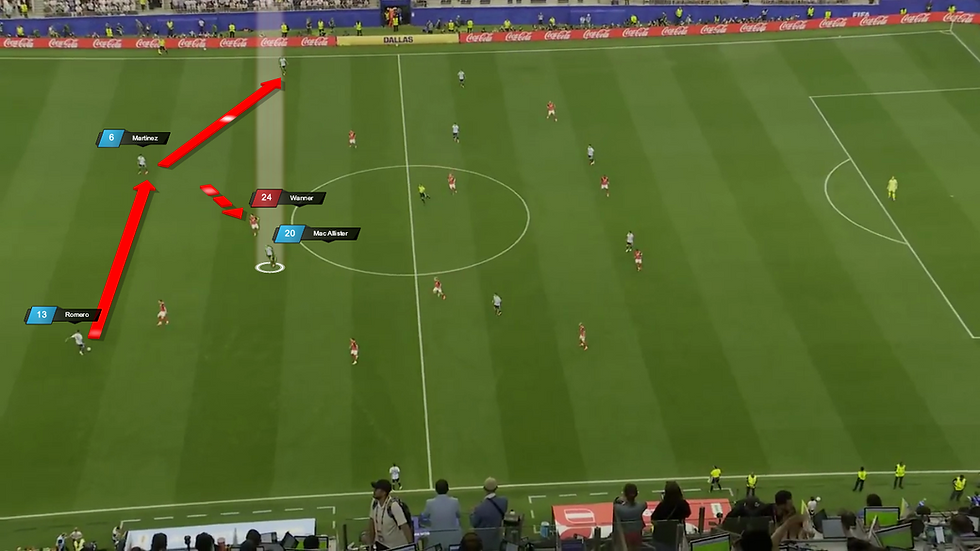
A possible adjustment would have been for Romano Schmid to position himself higher in these moments. This would have enabled him to press the return pass to Martínez, while Wanner remained responsible for Mac Allister.
Here's a polished English translation in the same analytical style as the rest of your article:
Austria could therefore have controlled the holding midfielder while simultaneously making it much more difficult for Argentina to recycle possession.
However, that happened far too rarely.
When the Press Loses Its Effect
The previous examples are isolated moments. The following sequence, however, illustrates the problem even more clearly.
The sequence does not begin with Austria applying a high press. Instead, it shows what happens when a pressing team gradually loses its ability to put the opponent under pressure.
Argentina had repeatedly found ways to bypass Austria's first pressing line. With every successful escape, Austria became more passive and increasingly lost the confidence to defend proactively further up the pitch.
That is exactly what can be seen in this sequence.
Austria defends in a deep block but fails to establish any pressure on the ball. Although the team remains compact behind the ball, it never manages to initiate an active pressing action. Argentina circulates possession comfortably, dictates the tempo of the game, and forces Austria into a purely reactive role.
The consequence is striking: the world champions complete 54 consecutive passes without Austria recovering possession or applying sustained pressure to the player on the ball.
Of course, the quality of the opposition has to be taken into account. Argentina is one of the world's best possession teams.
Nevertheless, this sequence is highly revealing when assessing Austria's pressing performance.
A team whose identity is built on proactive defending, high pressing, and winning the ball wants to avoid exactly these situations. In moments like these, it loses its greatest strength. Instead of dictating the game, it merely shifts across the pitch, chases the ball, and expends energy without being able to influence play.
That is why this sequence is particularly telling. Not because Argentina dominates possession, but because Austria is unable to establish any meaningful pressure on the opponent over an extended period.
The sequence of 54 passes is therefore not the root of the problem—it is its clearest consequence.
Conclusion
Austria tried to press Argentina — but not effectively. Too many tactical and structural problems prevented their high effort from producing a high return.
Ralf Rangnick often says that you cannot press a little bit, just as you cannot be a little bit pregnant. Either you press properly, or you do not. Austria wanted to press Argentina high, but failed to turn that intention into genuine control over the world champions' build-up.


Comments